

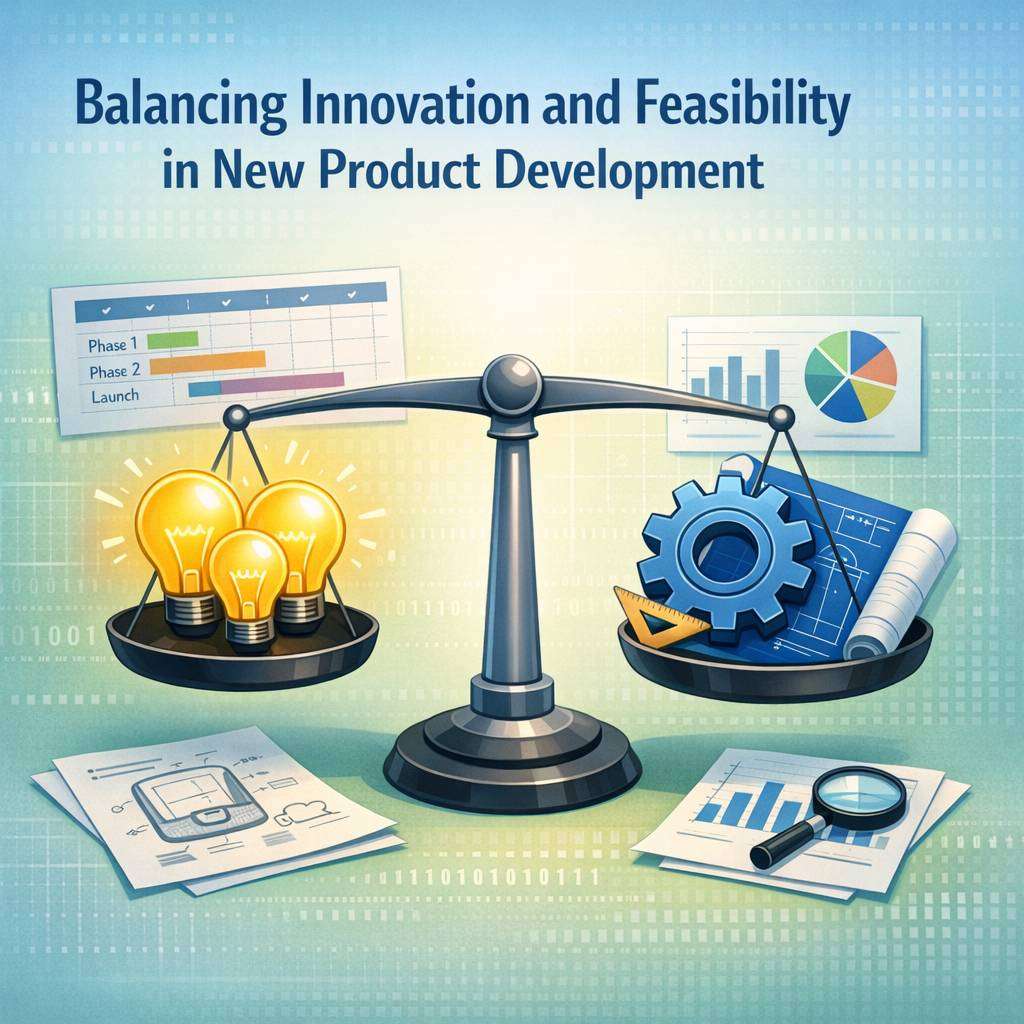
Innovation drives growth, but feasibility keeps it deliverable. In the realm of new product development (NPD), organisations must continuously bridge the gap between ambitious ideas and practical execution. A rigorous approach that balances creativity with engineering discipline ensures that innovative concepts translate into successful market offerings rather than aspirational fumes. By understanding both the opportunities and the constraints, product teams can prioritise features, align with customer needs, and optimise the path from concept to commercialisation. This balance is not accidental; it is cultivated through robust processes, clear governance, and access to the right expertise.
The journey from inspiration to launch is rarely linear. Teams often encounter conflicting pressures: time-to-market demands, budget limits, regulatory considerations, and the evolving preferences of end users. The most effective NPD strategies treat these tensions as driving forces rather than obstacles. A structured exploration of customer value, technical feasibility, and business viability helps organisations make informed trade-offs early in the development cycle, reducing risk and accelerating momentum toward a viable product.
NPD
In the context of npd, the emphasis is on a holistic view of the lifecycle, from ideation to post-launch iteration. A successful NPD programme begins with a clear problem statement and a validated hypothesis about customer value. This customer-centric stance guides concept screening, where ideas are evaluated against criteria such as desirability, feasibility, and viability. By calibrating these dimensions, organisations can identify which concepts warrant deeper investment and which should be deprioritised. Engaging stakeholders from marketing, engineering, manufacturing, and supply chain early on helps ensure that the proposed product scales beyond a single department’s enthusiasm.
To maintain momentum, adaptive learning loops are essential. Prototyping, testing, and real-world pilots provide rapid feedback that informs design refinements. In regulated sectors, parallel consideration of compliance and safety is non-negotiable; in consumer goods, usability and aesthetics often drive adoption as strongly as performance. The goal is to iterate toward a product concept that resonates with customers while remaining technically feasible and economically sustainable.
New product development drives growth by aligning customer insights with agile workflows and cross-functional collaboration. Teams prototype rapidly, test, and iterate to minimize risk while maximizing value. For practical strategies and industry insights, explore this resource: https://forward-npd.com/ and apply proven methodologies to stay competitive.
FAQ: New Product Development
What is new product development (NPD)?
New product development is the process of bringing a new product from idea to market. It involves idea generation, concept testing, business analysis, product development, testing, and commercialisation to meet customer needs and drive business growth.
Why is NPD important for my business?
NPD helps you stay competitive, respond to market trends, expand your product portfolio, diversify risk, and capture new revenue streams. A structured NPD process can reduce time-to-market and increase the likelihood of product success.
What are the key stages of the NPD process?
Common stages include:
- Idea generation
- Screening and concept development
- Business case and feasibility analysis
- Product design and development
- Prototyping and testing
- Market testing and validation
- Commercialization and launch
- Post-launch review and iteration
How do you generate ideas for new products?
Idea generation can come from customer feedback, market research, competitive analysis, technology scouting, internal brainstorming, and cross-functional collaboration. Techniques include brainstorming sessions, hear-from-the-customer exercises, and design thinking workshops.
How do you evaluate and select ideas to pursue?
Evaluation typically uses a stage-gate process, scoring ideas on feasibility, market potential, alignment with strategy, required investment, and risk. A go/no-go decision at each gate helps prioritise the most promising concepts.
What role does customer research play in NPD?
Customer research is critical. It validates needs, informs requirements, reduces risk, and helps ensure product-market fit. Methods include surveys, interviews, ethnography, usability testing, and concept testing.
How do you measure the success of a new product launch?
Key metrics include revenue, profit margin, market share, adoption rate, customer satisfaction, Net Promoter Score (NPS), time-to-market, and return on investment (ROI). Post-launch reviews help identify improvements.
What is a minimum viable product (MVP)?
An MVP is the smallest version of a product that delivers core value to early adopters and validates assumptions with real users. It helps test market demand while minimising upfront investment.
How long does the NPD process typically take?
timelines vary by industry and product complexity. Small consumer products may take months, while complex industrial or tech products can take 12–24 months or more. A well-defined roadmap and gates help manage duration.
What are common challenges in NPD?
Common challenges include scope creep, insufficient customer insight, misalignment between teams, budget overruns, regulatory or safety hurdles, and long regulatory approval cycles. Managing risk and maintaining clear ownership helps mitigate these issues.
How can I accelerate NPD without sacrificing quality?
- Start with a well-defined brief and clear success metrics
- Use rapid prototyping and iterative testing
- Involve cross-functional teams early
- Leverage existing platforms or technologies
- Streamline decision gates and governance
How does cross-functional collaboration improve NPD?
Cross-functional teams bring diverse expertise (marketing, design, engineering, manufacturing, sales). This reduces blind spots, speeds validation, and ensures the product meets market, technical, and operational requirements.
What tools or methodologies support NPD?
Popular approaches include Stage-Gate or Phase-Gate processes, Design Thinking, Lean Startup, Agile product development, and user-centered design. Collaboration tools, roadmapping software, and prototyping platforms also help.
How do you protect intellectual property during NPD?
Consider patents, trademarks, and trade secrets. Conduct freedom-to-operate searches, document development processes, and implement invention disclosures. Consult legal counsel to tailor IP protection to your product.
What is the role of prototyping in NPD?
Prototyping enables tangible exploration of concepts, user testing, design iteration, and risk reduction. It helps validate feasibility and user experience before committing to full-scale production.
How should startups approach NPD differently from established companies?
Startups often emphasise speed, learning, and flexible funding, using MVPs and rapid iterations. Established companies may rely on formal governance, larger budgets, and risk mitigation, but should still remain customer-centric and agile where possible.
What are best practices for global product launches?
- Localize features and messaging for target markets
- Ensure regulatory compliance and quality standards
- Plan supply chain and manufacturing readiness
- Build regional go-to-market strategies and support
- Monitor performance and gather feedback for iteration
How can you assess product-market fit?
Look for strong customer demand, repeat purchases, positive user feedback, sustainable unit economics, and clear differences from competitors. Use surveys, usage analytics, and A/B testing to validate fit.
What are some examples of successful NPD strategies?
- Customer co-creation and open innovation
- Platform-based product lines and ecosystem thinking
- Modular design for customization
- Data-driven optimisation and continuous improvement
How do I start an NPD project in my organization?
- Define a clear problem statement and objectives
- Assemble a cross-functional team
- Conduct initial market and user research
- Create a brief and evaluate ideas through gates
- Develop an MVP and plan for testing, learning, and scaling
If you’d like, I can tailor these FAQs to your industry or provide a printable PDF version.
new product development
New product development is a structured discipline that blends creativity with disciplined project management. A best-practice NPD framework typically encompasses opportunity assessment, concept development, design and optimisation, validation, and preparation for scale. Decision gates at each stage ensure that resources are allocated to ideas with demonstrable potential and a clear value proposition. This staged governance protects timelines and budgets while maintaining the flexibility required to pivot when new information emerges.
Cross-functional teams play a pivotal role in new product development. Designers, engineers, marketers, and supply chain specialists collaborate to quantify risk and uncover hidden dependencies. Value thinking—assessing customer benefit relative to cost and risk—helps teams prioritise features that deliver the greatest return. Methods such as conjoint analysis, Jobs to be Done, and minimum viable product testing provide quantitative and qualitative insights that inform go/no-go decisions. Maintaining a user-centred focus throughout the process helps ensure that feasibility checks do not stifle innovation but rather steer it in a marketable direction.
development of new products
The development of new products benefits from a clearly defined product architecture. Breaking the product into modular components enables parallel workstreams, reducing cycle times and enabling teams to explore multiple design variants. Architecture also clarifies where standardisation can deliver cost savings and where customisation is essential to meet differentiated customer needs. Early attention to manufacturability, reliability, and serviceability prevents late-stage surprises that can derail launches.
Risk management is another cornerstone of the development of new products. A systematic risk register, coupled with scenario planning, helps teams anticipate supply chain disruptions, regulatory changes, and performance shortfalls. Prototyping strategies—ranging from low-fidelity concept models to high-fidelity functional prototypes—allow for iterative testing at a fraction of final production cost. This approach preserves the balance between bold ideas and achievable execution.
product development new
When pursuing product development new, organisations should consider partnering with product development services that bring external perspective and specialised capabilities. External collaborators can accelerate time-to-market, provide access to new technologies, and help validate assumptions with independent insights. Yet, it is essential to establish clear collaboration structures, ownership of intellectual property, and transparent communication channels. A well-defined contract language and governance framework minimise ambiguity and align incentives across parties.
The role of a product development consultancy is often to catalyse momentum and provide objective evaluation. A consultancy can introduce best practices, robust stage gates, and evidence-based decision-making while remaining sensitive to the client’s strategic priorities. For product development companies, the emphasis should be on delivering end-to-end value: from discovery and ideation to rapid prototyping, testing, and scalable production planning. Selecting the right partner means assessing their track record, methodologies, and cultural fit with your organisation.
product development services
Product development services encompass a spectrum of capabilities, including market research, concept screening, industrial design, electrónica engineering, software integration, and regulatory compliance. A comprehensive service offering ensures that all critical dimensions are addressed within a cohesive plan. By integrating market intelligence with technical feasibility studies, product development services help de-risk the project and maintain alignment with business objectives. This holistic approach supports sustainable innovation, enabling products to deliver customer value while meeting cost targets and quality standards.
Choosing a product development consultancy or a product development company often hinges on strategic fit rather than sheer capability. Leaders should evaluate how potential partners approach problem framing, risk management, and stakeholder engagement. A partner that emphasises collaborative governance, transparent milestones, and measurable outcomes is more likely to deliver a successful product that performs in the real world, not just on a drawing board.
new product development companies
New product development companies increasingly focus on agile, customer-centric methodologies that marry speed with disciplined engineering. By adopting iterative release strategies and continuous feedback loops, these organisations can bring differentiated products to market faster while maintaining quality and reliability. The best firms integrate design thinking with robust engineering practices, ensuring that every feature serves a purpose, is technically feasible, and contributes to the overall business case.
In essence, balancing innovation and feasibility in new product development requires a deliberate, integrated approach. By aligning user insights with technical reality and commercial viability, organisations can navigate the tension between aspirational innovation and practical delivery. The outcome is not merely a new product but a sustainable capability: a repeatable, scalable process that consistently delivers customer value without compromising feasibility.