
Innovation is the lifeblood of growth, and new product development (NPD) programmes are the engines that propel businesses forward. For organisations across sectors, the challenge is not merely to generate ideas but to translate them into successful, market-ready offerings. As a seasoned new product development consultant, I have observed that the most durable competitive advantages come from disciplined risk management embedded early in the NPD lifecycle. By anticipating potential derailments, companies can preserve capital, protect timelines, and sharpen value delivery to customers.
In today’s climate, organisations ranging from nimble startups to established product development companies increasingly rely on a combination of internal expertise and external capabilities. Whether you are a product development outsourcing partner or a dedicated product development consultancy, the ability to identify, quantify, and mitigate risks before they become critical is what distinguishes successful ventures from expensive missteps. This article outlines a practical framework for risk management in NPD, with actionable steps that can be implemented by product development services teams across the value chain.
Proactive risk identification and governance
Effective risk management begins with robust governance and rigorous early discovery. At the outset of any NPD programme, assemble a cross-functional governance group that includes product strategy, engineering, manufacturing, quality, regulatory, regulatory affairs, and commercial representatives. This ensures diverse perspectives are applied when identifying risk categories, such as technical feasibility, supplier reliability, regulatory compliance, market misalignment, and cost volatility.
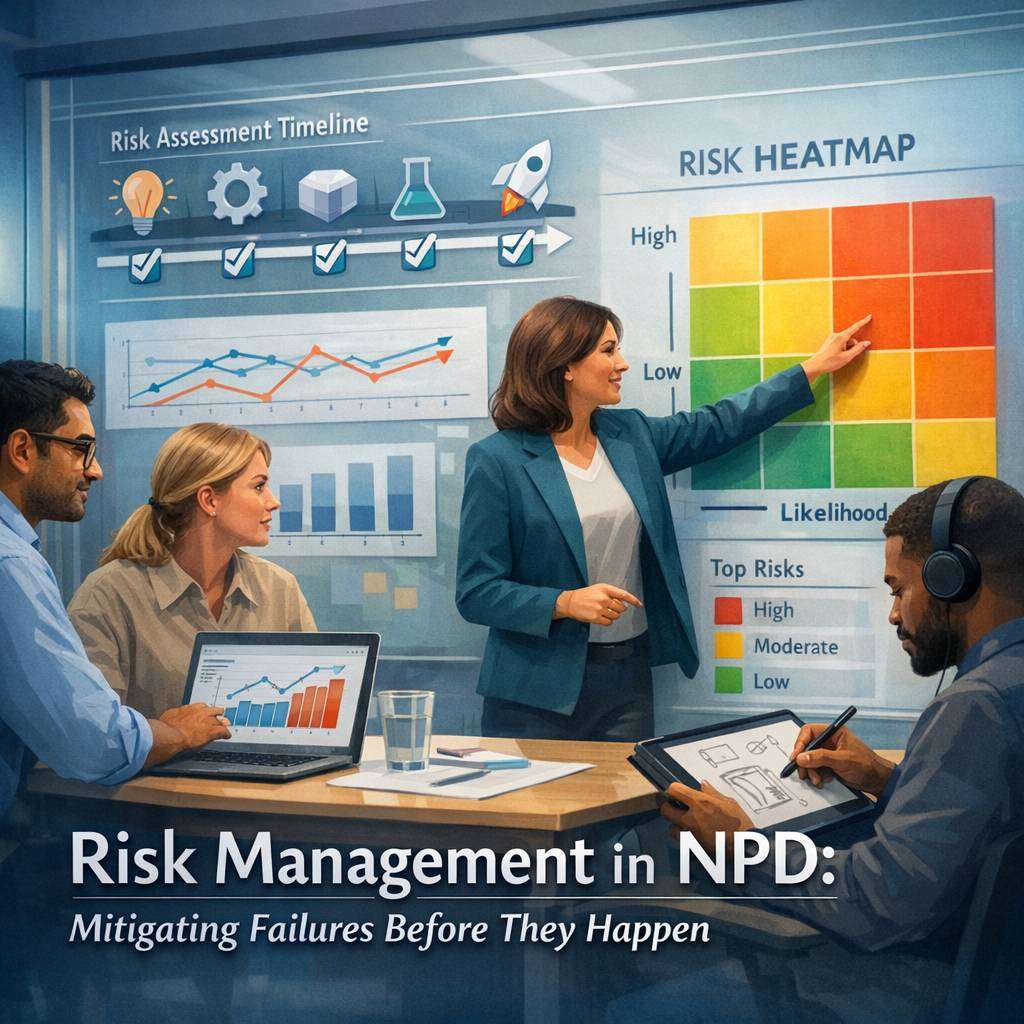
A structured risk register is essential. Each risk should be clearly defined, assigned owners, scored for likelihood and impact, and linked to mitigations with clear deadlines. In my experience as a new product development consultant, maintaining an active risk log enables teams to prioritise interventions and track trends across multiple programmes. For product development outsourcing partnerships, align risk ownership with the service level agreements (SLAs) and ensure escalation paths are well defined so vendors can respond rapidly when early warning signs emerge.
Design, validate, and de-risk: iterative testing that matters
NPD success hinges on validation activities that truly de-risk the project. Rather than conducting checks at the end of the development cycle, embed validation throughout the product development process. Early-stage design reviews should be accompanied by failure mode and effects analysis (FMEA), tolerance analysis, and design of experiments (DoE). These tools help quantify risk drivers and reveal hidden assumptions before resources are committed to costly build cycles.
Rapid prototyping and testing are essential, particularly for complex or regulated products. If you operate within the realm of medical devices, consumer electronics, or industrial equipment, guidelines and standards often require rigorous clinical or safety validation. Shape a validation plan that scales with project complexity and leverages outsourced capabilities when appropriate. A disciplined approach to testing reduces the risk of late-stage redesigns, helps safeguard regulatory submissions, and improves overall project velocity.
Consider scenario planning and sensitivity analysis for cost and supply risks. For example, fluctuating commodity prices, alternate sourcing options, and single-source dependencies can threaten project timelines. A proactive product development consultancy can help quantify these risks and build mitigation strategies, such as dual-sourcing, phased supplier qualification, or design-for-supply concepts that preserve flexibility without sacrificing performance.
Market alignment, scalability, and governance of product development
The ultimate measure of successful NPD is whether the product delivers the intended value to customers at scale. Market-facing risks—such as misreading customer needs, pricing pressures, or channel misalignment—require ongoing, data-driven oversight. Establish a cross-functional stage-gate process with explicit go/no-go criteria anchored in market research, customer validation, and early commercial pilots. This ensures that critical risk indicators trigger a deliberate decision to adjust scope, timing, or business case rather than allowing a project to drift towards failure.
Leverage the breadth of product development services available through product development companies and product development outsourcing providers to strengthen risk controls. External partners can offer independent verification, benchmarking, and regulatory expertise that complements internal capabilities. When selecting a partner, assess their risk management maturity, track record with similar products, and ability to align incentives with your programme milestones. A focused product development consultant can help integrate best practices across strategy, design, and execution, ensuring risk management is not treated as a separate activity but as an engrained discipline.
Managing supply chain and manufacturing risks is equally critical. Early supplier qualification, visits to production sites, and capability assessments support decisions around make versus buy, lead times, and scalability. Prepare contingency plans for potential disruptions—such as supplier bankruptcy, quality issues, or geopolitical events—and build buffers into project plans where feasible. A well-structured manufacturing risk plan protects deployment timelines and preserves product quality in the transition from prototype to high-volume production.
Governance, culture, and continuous improvement
A mature risk management culture grows from leadership commitment and continuous improvement. Establish regular risk reviews with senior stakeholders to ensure visibility, accountability, and timely escalation when new risks emerge. Use metrics that reflect both probability of risk occurrence and the severity of impact, such as schedule variance, defect densities, cost-at-completion, and time-to-market under varying scenarios. Publicly track these indicators to reinforce a culture of accountability and data-driven decision making.
Training and capability development are vital. Equip internal teams and partners with practical risk management techniques—risk mapping, escalation protocols, and decision-making frameworks that emphasise evidence and pragmatism. For new product development companies, investing in capability-building pays dividends through faster identification of risks, smarter trade-offs, and more resilient project portfolios.
In closing, risk management in NPD is not a one-off exercise but an ongoing discipline that spans strategy, design, validation, and market execution. By embedding proactive risk identification, iterative validation, market alignment, and robust governance into your NPD programmes, you can mitigate failures before they happen. Whether you are working with a new product development consultant, engaging a product development consultancy, or leveraging a network of product development outsourcing partners, the objective remains the same: deliver compelling, high-quality products that meet customer needs on time and within budget.
NPD new product development drives innovation, market fit, and faster time-to-revenue. Explore effective strategies, insights, and case studies at https://forward-npd.com/ to optimize processes, collaboration, and decision-making across teams and stages of the product lifecycle.